
Episode 3 - 3 Critical Communication Steps that Create Independent Staff
Feb 24, 2026
Show Notes
Want to learn more about TrueLink? Contact Kyle McDonough: call at 628-239-3963, or you can email him at kyle.mcdonough@truelinkfinancial.com
Transcript
Today, we’re talking about one deceptively simple goal that changes everything about supervision: staff independence.
No, we’re not talking about they can do it if I remind them, or they’ll get it done if I follow up, or even if I nag, beg, plead, and do that for days, I’ll actually get the work done that’s supposed to be done. We’re not talking about any of that.
True independence means doing the work correctly and on time without you, the supervisor.
It is expecting staff to do their work correctly, on time, without requiring ongoing supervision is the standard. This is normal work.
If you’ve been in my trainings, you know I often talk about the expectations of me as a 16-year-old worker at Wendy’s. I was expected to do my work correctly and on time, make appropriate decisions, and make sure that the food was done per regulation within the allotted timeframe.
You should have the same expectations of your staff. Once they are trained, they should be able to do the job correctly, on time, and without you.
Welcome to the Provider Power Moves Podcast. I am your host, Sara Sherman. Here, I leverage my 35 years of experience in the field to give you practical steps that create big results in your agency and in your workday.
This episode is brought to you by TrueLink. TrueLink partners with hundreds of IDD organizations nationwide to streamline how clients receive and use their funds. Many programs still rely on paper checks, cash, and manual receipts — and this creates risk and makes audits difficult.
The TrueLink platform replaces that entire process with reloadable Visa debit cards, built-in spend controls, and audit-ready reporting. TrueLink keeps clients safer, gives staff back valuable time, and provides clear visibility into every transaction. If your organization is interested in learning more, check the show notes for contact information.
Independent staff are happier staff. They aren’t being corrected all the time. They can confidently execute. They get to make that difference you promised they could make when they chose to work for your organization.
Think of one staff person you regularly remind or rescue. Are you training them or supporting them for independence? Or are you training them for dependence?
And if you don’t supervise anyone, think about your supervisor. When you need help, when you need correction, does the help that you get empower you to be more independent in your job — or more dependent?
So today, we’re going to talk about those three critical communication steps that support independent staff.
And we’re going to start with the least talked about, but highly important, communication skill: listening.
Active listening builds competence because you’re really hearing what your staff are telling you.
When management trains, when management corrects, it’s all about telling them— and not at all about listening to them.
And let’s face it: if we were great about training and correcting, staff would not need to ask an endless array of questions, because they would have all the knowledge they need to execute independently.
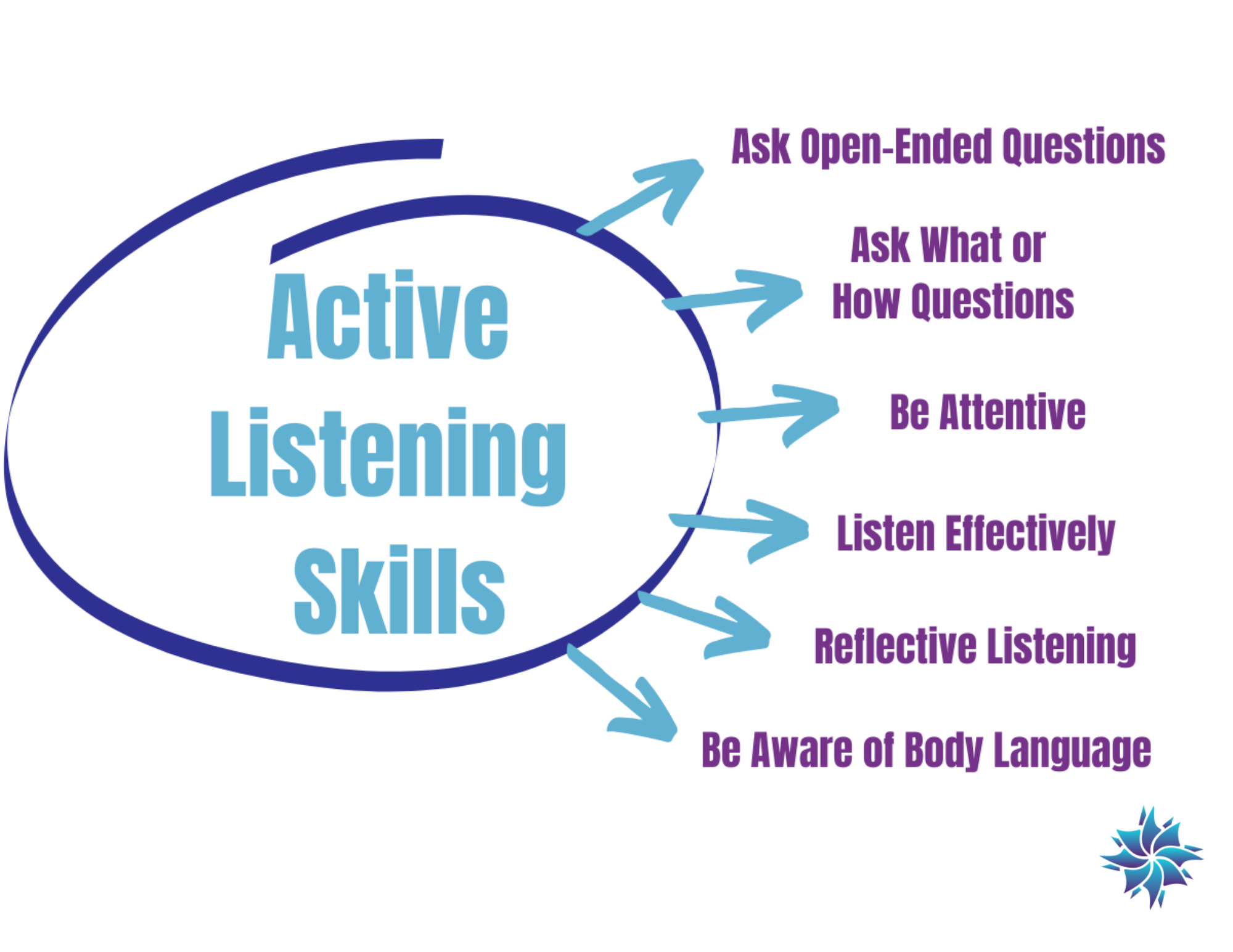
There are six steps to active listening.
First, we want to ask open-ended questions. These are questions that cannot be answered with a yes or no response.
So instead of saying, did you do the work that’s on the schedule? you can say, tell me about the work that you did on the schedule. Tell me how you did the work on the schedule. Describe your day to me.
These are all open-ended questions.
Ask what or how questions. So if you’re stuck on how to ask a good open-ended question, simply start your question with what or how.
What and how questions cannot be answered with a yes or no. Easy peasy!
Be attentive. This means put your phone down. Look someone in the eye. Don’t be distracted. Don’t be talking to several people at the same time. Give the person who’s speaking to you your full attention.
Listen effectively.
Listening effectively means that you’re hearing what’s not being said. For example, if you ask someone how they’re doing and they say, fine, they’re probably not fine.
So listen for the messages that aren’t being verbalized and confirm your understanding of those.
Use reflective listening.
So if someone comes to you and they appear to be frustrated, confused, angry, excited... simply reflect that back to them. It sounds like you’re really excited about this. That’s great. Tell me more. It sounds like you’re really frustrated. Tell me what’s going on.
And finally, be aware of your body language. If your arms are crossed, if you’re scowling, if you’re tapping your foot, if you’re rolling your eyes, people don’t believe that you’re really listening. You could be — but you don’t look like it.
Have an open stance. Be relaxed. Listen. Give someone your full attention and listen carefully.
Number two: praise without confusion.
When you praise someone’s performance, you need to be honest and specific. Sometimes supervisors think they can praise people into productive performance. It’s not true.
You can praise people who are working correctly — and who maybe don’t feel confident — into feeling confident and delivering confident, productive performance.
But you cannot praise someone who’s doing work incorrectly by telling them they’re doing a great job and then expect them to change their behavior. It just doesn’t work.
Let me give you an example.
When my son was in kindergarten, I volunteered in class once in a while. The teacher said, Hey everybody, let’s go to the big blue rug and we’re going to do all of our sight words.
So all the kids were so excited, including my son who ran over to this circle, and everybody sat cross-legged, and were excited to see the words the teacher was going to put up.
She put up the first word. Many of the children read the word correctly.
My child did not.
The teacher said, Great job, everyone.
The teacher put the next word. Many of those children said the word correctly. My child did not.
The teacher said, Great job, everyone.
This continued throughout their exercise.
When we got home, I said to my son, Hey, you didn’t know any of your words. We need to work on that.
And he said, No, it’s okay. She said we did a great job.
This is what happens when we try to praise people who are doing the work incorrectly. You cannot praise them into productive performance, because they will believe what they are doing is acceptable.
And they believe that if it were not acceptable, there would be some sort of negative consequence or correction.
We’ve all heard the stories of teachers who spoke positively over students who no one thought would amount to anything.
In that case, the teacher is offering encouragement and building confidence. The teacher is not failing to identify incorrect responses and letting those go through.
You can and should offer encouragement and seek to build confidence.
You cannot lie to someone about their errors and expect them to right those errors.
Supervisors who are uncomfortable with confrontation, and/or don’t know how to address poor performance, are inclined to try to praise someone toward changing their behavior.
If this is you, seek the training you need so that you can support your team correctly.
Number three: provide clear instructions that stick.
If staff cannot repeat the steps that you’ve given them, they cannot successfully execute the task. If staff cannot repeat the steps you have given them, they cannot successfully execute the task.
Ask them to tell you what they understand. Ask them to tell you what they understand.
Here’s what that looks like.
You’re going to give someone instruction to take Steve to the barber.
You say, He likes to have just a trim on his hair. He likes a tight shave with a beard trim, and he does not want his ears to show. Now, tell me what you understand.
Did you catch that?
Asking your staff to tell you what they understand is a very different idea than saying, Hey, take Steve to the barber. He likes to have just a trim, likes a tight shave with a beard trim, and doesn’t want his ears to show, okay?
What will your staff say? They will say yes.
Do they say yes because they don’t care? Nope.
Is it because they want to be disrespectful to Steve? No.
Is it because it will be amusing to defy your instructions? No.
It’s because they believe they do understand. And they did. They understood all the words that you said.
Think about the number of times you’ve given instructions only to have staff fail to correctly implement those instructions.
Probably many times.
And how many times do you feel frustration with those staff?
Again, probably many times.
So here’s my challenge to you.
After you give instructions, ask the person what they understand.
If you did your job well, they’ll say all of your instructions back to you.
If they cannot repeat your instructions, they don’t have it yet.
You will be amazed at the number of times people say yes, they understand, and they’re ready to go forward — and they cannot tell you all of the steps you just gave them.
When they get it wrong and they don’t have all the information, that tells you that you need to say it again. It’s that simple. Just give the instructions again.
Repeat this process until staff can repeat the instructions correctly. If they cannot repeat the instructions correctly, they cannot execute correctly.
The number one way you know staff understand what you are teaching them to do — or asking them to do — is that they can say all of the words back to you correctly.
Now, sometimes people get upset when you ask them what they understood after you’ve given instructions. They feel challenged, insulted, or questioned.
If you encounter somebody who reports that being asked to repeat their understanding is problematic, do this: tell the person you’re checking yourself. You’re checking to make sure that you have provided good instruction.
If the person doesn’t like you, they’re going to listen very intently because they want to find your errors.
And if they do like you, or they want to do a good job, they’re going to listen intently because that’s their intended outcome.
Either way — mission accomplished.
And by the way, the haircut example is a real story.
I was working with an agency, and a supervisor was in this training and he got the tip to make sure staff can say the information back to you.
And so he came back a few days later and he said, Oh my gosh, this really works.
Because he remembered to do it two times. And on the third time, when he sent a DSP off to help someone get a haircut, he failed to ask them to repeat the instructions.
And the person came back with a very different haircut than expected.
And instead of being frustrated with the staff person, this time the supervisor said, You know? This is on me. I didn’t check to make sure you were clear and you had it all. It’s not your fault.
Now imagine what it feels like as a staff person when you make an error of that nature and your supervisores says to you You know what, this was my fault. I didn’t check well enough. Let’s work together better moving forward.
No decrease in morale. Clearly a good example of why the listening and the saying it back are so important.
And now your staff person is going to help the supervisor by saying, Let me make sure I’ve got this, and they say it back to you — because you’re both committed to serving the individual, and you understand that communication can be challenging, even when we don’t realize it.
So you’re both on the same page, and you’re both implementing this technique, not only what a wonderful workday that you’ll have, but what a wonderful life the person that you’re serving will have — because they won’t experience these mistakes anymore moving forward.
All right, quick recap.
Communicate for independence. The intended goal is that people can do their work correctly without the supervisor standing there.
Use active listening skill componets, and check the show notes for a link to a graphic that lists all six.
Praise without confusion. Be honest and sincere about your praise. You can always still encourage — just don’t praise when it’s not earned. It sends a very confusing message to your staff person.
Confirm that people understand what you’re telling them. Ask them to simply say back their understanding so you both know you’re on the same page, and the work will be done correctly.
Let me know which of these steps you’ve tried and how it went.
And if you have a question, send me a note at Sara — (S-A-R-A) — sara@providerpowermoves.com, or drop it in the comments wherever you listen to this podcast.
Until the next time — power on.
Yours free: 🐝 "5 Power Moves That Will Make or Break Your Provider Success"

As a sought-after problem solver in the IDD community, Sara Sherman helps providers, governments, and organizations solve their most challenging problems once and for all.
With decades of experience in all aspects of the developmental disabilities system, Sara teaches practical, implementable, and repeatable steps that produce measurable and sustainable results to ensure those problems stay gone for good.